
Step 6 / The Idea of Bitcoin
Why a copy is not a payment.
A payment needs permission, available money, and an agreed record.
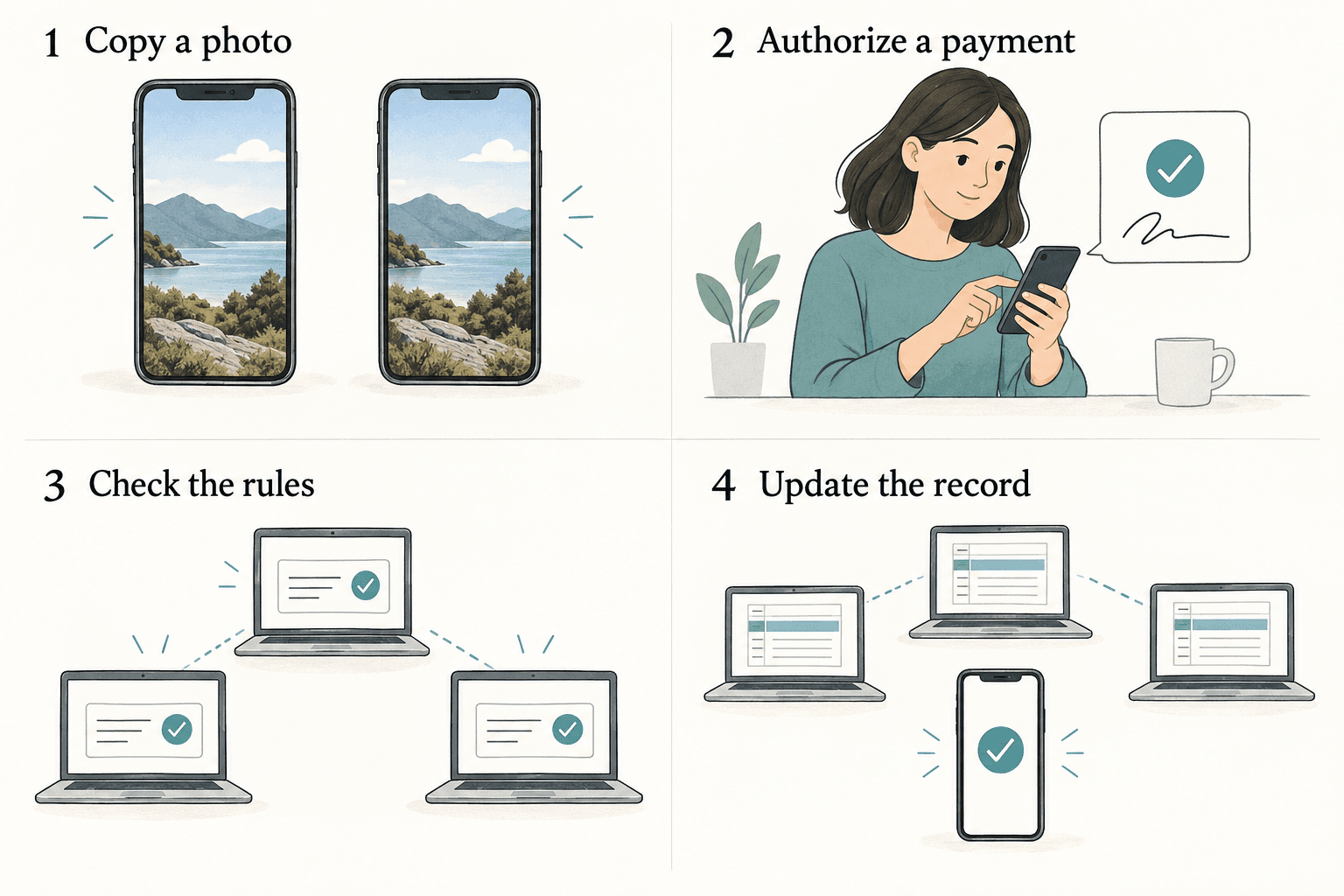
Send a friend a photograph. You still have your copy, and your friend has one too. That is useful when you want to share a picture.
Now imagine Maya has only enough money to pay one person. She sends two payment requests, both using that same money. Each recipient sees a request saying they should be paid. The system needs to stop both requests becoming accepted payments. Trying to spend the same money twice is called double spending.
Copying the message does not make more money
Bitcoin does not make a coin-shaped file that can never be copied. Instead, it keeps a shared history of payments. Computers use that history to check which amounts have already been spent and which remain available.
Copying Maya’s payment message does not add money to that history. Neither does copying her wallet. A payment still has to pass three checks: did the right person approve it, is the money available, and which record should the computers follow?
These questions help you understand what a coin’s network actually does. Its name, logo, and price chart cannot explain those checks.
Who keeps the payment record?
A bank can keep the official payment record under one organization’s control. It checks who is asking to pay and whether the money is available. Saving another copy of your bank statement does not give you a second balance.
Bitcoin lets separate people run software that checks the shared record. A computer taking part in the network is called a node. A full validating node checks payments and groups of payments, called blocks, against the rules it runs.
Maya uses a secret piece of data to approve her payment. It is called a private key. Her wallet can use it to make a digital signature that others can check without seeing the secret.
That signature answers whether the required key approved the request. This approval is called authorization. The node must still check the record to see whether the money is available. Approval alone cannot make the same amount spendable twice.
Both recipients can keep the image. Sending it does not remove the original.
What if the requests arrive in a different order?
Suppose Maya’s first request pays the baker and her second pays the miller with the same money. One node receives the baker’s request first. Another receives the miller’s request first. If each accepts only the request it saw first, they end up with different records.
The nodes need a way to reach the same payment history even when messages arrive at different times. They need rules for allowed payments and rules for choosing which allowed history to follow. This process of reaching agreement is part of consensus.
We also need to ask who controls the computers. One company could own twenty servers and direct all of them. There would be twenty copies of the record, but only one organization in control.
Sharing control among separate participants is called decentralization. To judge it, ask who can check the record, who can propose an update, and who can make others accept a changed rule. A project’s founders may have influence without controlling every part of the network.
One operator controls all four copies. The machines are distributed; their authority is centralized.
One person can make many usernames
Imagine an open network gives each username one deciding vote. Joining is free. One person makes thousands of usernames and now appears to be thousands of voters.
The network has counted names as though each belonged to a separate person. This is called the Sybil problem. More names do not necessarily mean more people making independent decisions.
Bitcoin uses a method called proof of work to help choose between histories that follow its rules. It does not count free usernames to make that choice. Other systems use different methods, including assets set aside as stake. We will examine those methods and the checks they still need.
Even an agreed record has limits. A record can say that a parcel arrived, but that entry does not prove a person delivered it. Agreement about what the record says is different from proof of what happened outside the network.
The idea to keep
For a payment, ask three things. Was it approved by the required key? Does the record show that the money can still be spent? And which allowed history should the nodes follow?
Next, we will look at earlier tools that helped answer those questions. Each solved part of the problem, with its own limits.