
Class recording
1.3 When Money Becomes Easy to Make
Watch this part of the class, then work through the lesson below.
Step 1 / Make Sense of Money
When Money Becomes Easy to Make
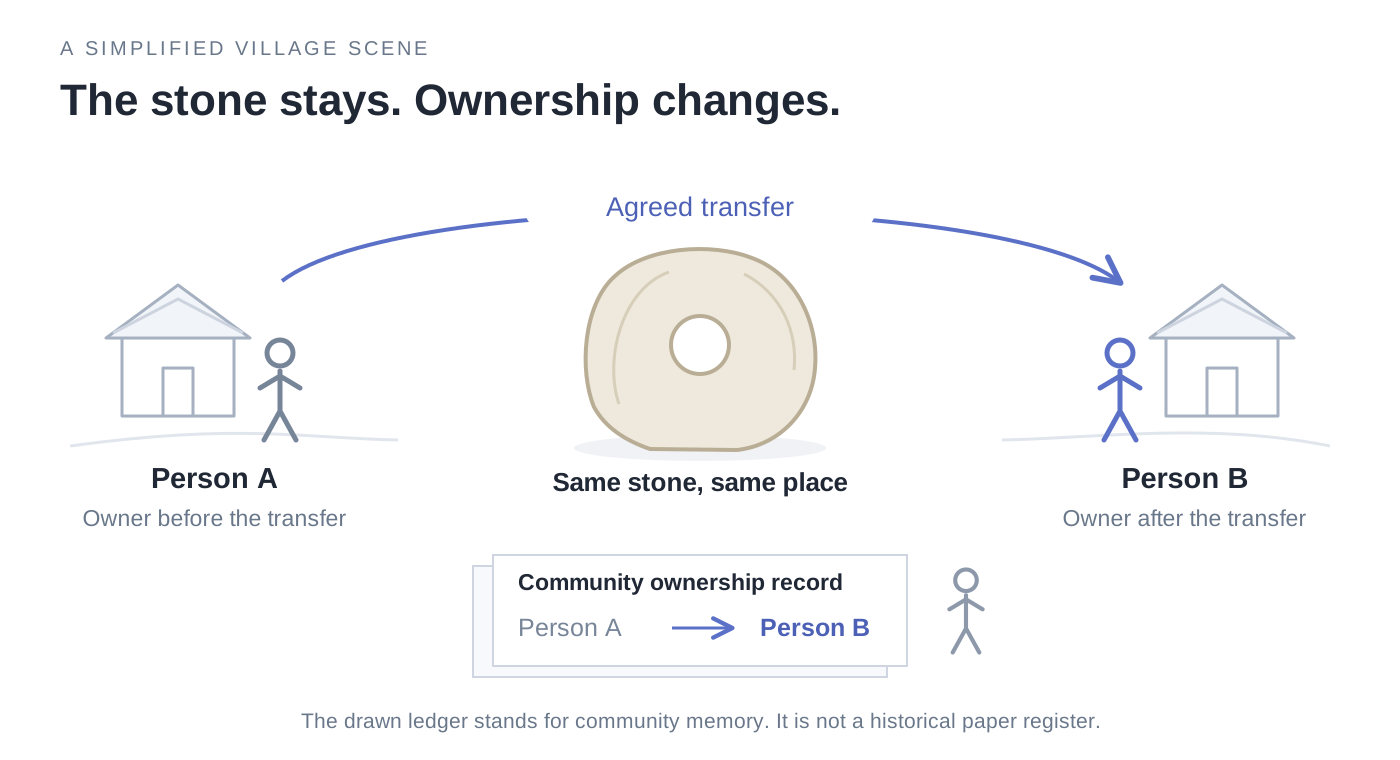
A stone can stay in place while its owner changes. Making more stones brings a different question.
Imagine receiving a payment that is too heavy to carry home. You might still be able to use it if other people agree that it belongs to you. The history of stone money on Yap helps explain how that can work.
That history also raises a second question. What happens when new tools make it easier to produce more of the thing people use as money? To answer it, we need to look at both the objects and the people who accept them.
The stone that stayed beside the path
On Yap, an island in Micronesia, people used carved stone disks as valuables in important exchanges. The stones are called rai. Many came from Palau, hundreds of miles away.
A large stone did not always need to move when it changed owners. People could agree who owned it and pass that knowledge on by speaking to each other. Those shared histories helped people keep track of ownership.
Picture this simplified example. Family A owns a stone beside a village path. The family agrees to give it to Family B in an exchange, and the community accepts Family B as its new owner.
The stone is still beside the path. Family B now owns it because the people involved recognize the change. The object’s location and the right to use it in an exchange are two different things.
Two stones, two histories
Knowing the owner was only part of the story. People could also care about the work of making a stone, its journey to Yap, its earlier owners, and its place in community life.
So measuring two stones would not tell you everything about their value. Two stones of the same size could have different histories. People could value one more than the other because of those differences.
Similar dimensions do not make two rai interchangeable. Arrival, ownership, and use can matter.
A new way to bring in more
In the 1800s, traders including David O’Keefe helped Yapese people cut stones from quarries and bring them home. Ships and newer tools made the work easier. More stones could reach Yap.
But the newer stones did not erase the histories of the older ones. People could value them differently. Easier production changed how many stones were available and what people thought they were worth. It did not make every stone worthless.
This gives us two separate questions. How easy is it to make more of the object? And do people accept a newly made one as equal to an older one? The answers help explain what a growing supply, or total amount, can change.
Other places used other objects as money. Museum collections include cowrie shells used as money in West Africa and European glass beads traded there. Some of this trade was tied to the transatlantic slave trade: people were enslaved, sold, and forced across the Atlantic.
The history of these objects involved more than how easily they could be made or collected. Trade, what local people wanted, and the use of force all mattered. These were different systems. Their histories do not show that cheaper production always destroyed the money people used.
Your tokens stay the same, but the total grows
To see one part of this clearly, use a fictional example. A town has 1,000 tokens, and each token counts the same. You own 100 of them. Your share is 100 ÷ 1,000 = 10% of all the tokens.
A workshop makes another 1,000 tokens and gives them to other people. The town now has 2,000 tokens. You still have 100, so your share is 100 ÷ 2,000 = 5%. Your token count stayed the same while your share of the total fell.
Now imagine that making new tokens takes a lot of work. The total would be harder to increase than if a workshop could quickly make as many as it wanted. This difficulty is what people mean by hard money when comparing how money is produced. Its supply is relatively hard to expand.
Easy money, in this sense, has a supply that is easier to expand. These terms describe how easily more money can be made. They do not describe how hard a material feels or how easy it is to make a payment.
The token math tells you your share of the total. It does not tell you that prices must double. People might save the new tokens, spend them on different things, or make more goods for sale. They might also become more or less willing to accept the tokens.
What your tokens can buy is their purchasing power. That depends on what happens after the new tokens arrive, not just on the number printed in the example.
Fictional tokens · your holding stays at 100
More tokens, the same holding
You hold 100 of 1,000 tokens. This is the starting scenario.
Each button selects a scenario; it does not add tokens repeatedly. Your share of the supply is different from what those tokens can buy.
More money is not the same as more goods
Think about a bakery. Making more bread gives people more food to buy. Making more tokens does not itself bake another loaf.
The same is true of homes and medical care. More money alone does not build a home or provide a doctor’s time. Someone saving for the future needs to think about what their money will buy, as well as how many units they hold.
The idea to keep
When the amount of money grows, ask how the new units were made and who received them. Then ask why people accept them and what rules people follow when using them. Harder production can limit new supply, but people’s willingness to hold and accept the money still matters.
Yap shows why we need both sides of the story: the objects and the people using them. Next, we will see why gold and silver became useful forms of money and what problems they still left to solve.